The farm where pampering pigs is simply good taste
Reporting by The Farmer Magazine, powered by NSW Farmers - Nanette Holliday, Michelle Hespe, August 22, 2023
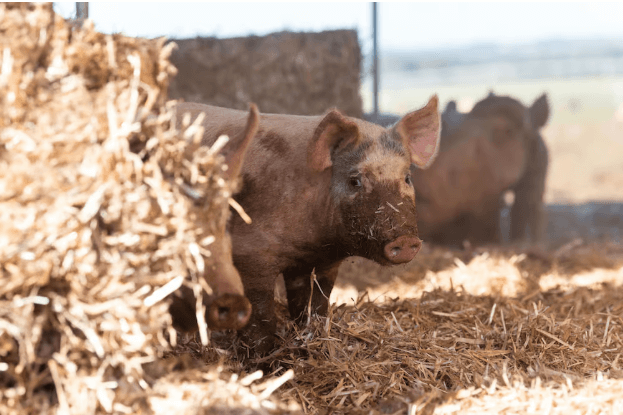
Despite most people’s vision of pig farming and the saying, happy as a pig in mud, David Refalo from Refalo Free Range Pork likes to do things differently at his 155-acre Bangaroo Ridge pig farm property in Canowindra. It’s not that their pigs don’t like mud, but his piggery avoids wallows and embraces sprinklers.
Pigs cover their bodies in mud to keep cool and protect their fair skin from sunburn when it’s hot, David says.
Over the past 15 years, David has developed a range of sustainable and innovative pig farming practices. His pigs not only roam totally free range across the pastures, but there are over 34 custom- made shelters spread around the property, protecting them from Australia’s harsh elements without the need to wallow in mud.
David’s shelters are all fitted with sprinklers that can drop temperatures by up to 20 degrees during summer. David designed two shelters himself, the Farrowing Shelter and Dry Sow Shelter. The other two Eco Shelters on the property come from Adelaide.
The farrowing shelters are made from coolroom panelling with intensive sow flooring that keeps the piglets warm and dry during wet periods. When the piglets are warm and dry, they use their energy to grow, not keep warm, says David.
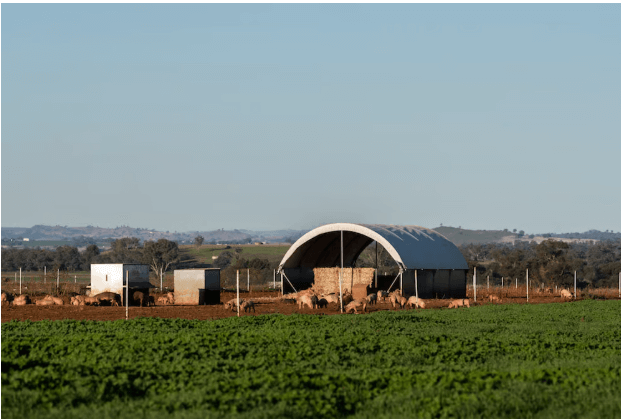
The 155-acre property is complete free range.
“The farrowing shelters are made from coolroom panelling with intensive sow flooring that keeps the piglets warm and dry during wet periods. When the piglets are warm and dry, they use their energy to grow, not keep warm.
DAVID REFALO
Farmer, Refalo Free Range Pork”
The outside roof sprinklers maintain a comfortable temperature for the sows while ensuring the straw remains dry during summer.
His other shelters have roof sprinklers, with moss sprinklers (or misters) underneath to keep the pigs cool and comfortable year-round. All the shed sprinklers are computer automated with adjustable settings to compensate for the varying heat throughout summer.
David’s environmentally friendly approach to pig farming has created the perfect balance for his pigs, achieving a light pink, high-quality meat.
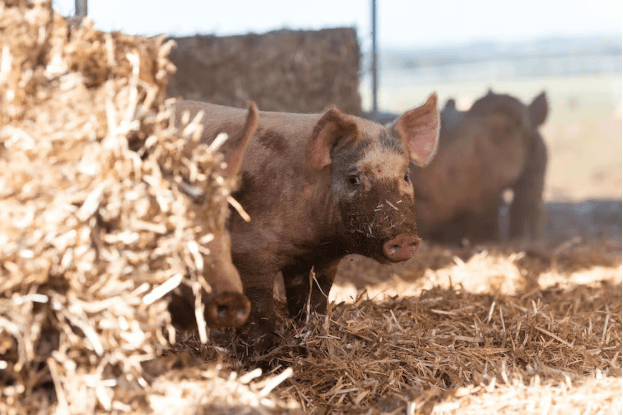
Twenty-five of the 120 sows farrow every month, providing plenty of new faces on the farm.
The shelters significantly reduce the risk of sunburn and lower summer infertility rates, he adds.
The pigs are much happier outdoors, resulting in better conditioning and higher production outputs.
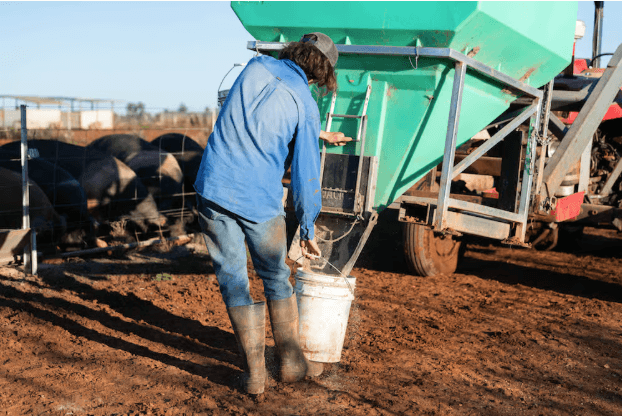
On-farm grazing is supplemented with various grains, handfed to the pigs daily.
Bangaroo Ridge is a 100 per cent free-range pig farm, with 120 sows and around 800 pigs in total. When David bought the property in late 2016, it was a vineyard with two acres of timber cover and no structures other than a shed and small demountable office, which he converted into a liveable flat for him and his then fiancé Sarah, whom he married in September 2020. In January 2017, he moved his 10 sows from his parents’ hobby farm on the outskirts of Sydney.
Today, more than 55 per cent of the vineyard has been cleared for his piggery, and he has built a four-bedroom, all-brick home on the property. Like his father, David is a qualified bricklayer, but farming was always his true passion. Sarah and David now have a 10-month-old daughter, Margretta Georgina.
“Georgina was my grandmother’s name,” says David. “Her stories of the family farm in Malta developed my curiosity about pig farming. I then read every book I could get my hands on about raising pigs.”
Refalo family pig farming in Malta extends back into the 1800s. When David’s father’s grandparents came to Australia in 1955, they established a 10-acre vegetable market garden with some pigs in Horsley Park. When David’s grandfather passed away, his grandmother moved in with his parents, Julian and Maria, who had a 5.5-acre property in Kemps Creek where they grew vegetables and sold them at the Sydney Markets.
“I never knew my grandfather or had any association with pigs,” says David. “But for three years, I hatched eggs and raised chickens, geese and ducks before Dad relented and gave me a pig when I was 13.”
David learned how to artificially inseminate his pig and, within a short time, was selling piglets through the local Trading Post paper and making a small fortune.
“Dad sectioned off just two acres of the hobby farm for my pigs,” David explains.
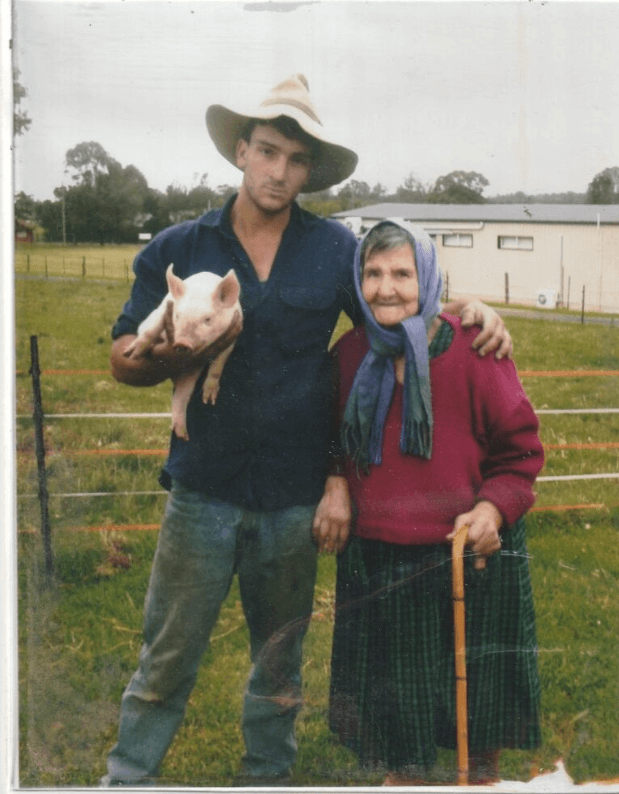
David with his grandmother, Georgina Refalo.
I’ve always free-ranged them. I believe it produces a different flavoured pork.
To create the best all-outdoor pigs for his herd, David first tested the genetics of his original Large White, Landrace and Duroc pigs, but the results were not successful. A friend then suggested trying a Hamrock, an F1 Hampshire–Duroc cross.
“This resulted in a black sow with a mostly white band over their shoulders,” he says. “Their tougher skin was perfect.”
“All our legs of ham are Refalo. The skin is thicker and softer, the meat-to-bone ratio is higher, and the colour is lighter and more flavoursome.”
RICHARD ODELL
Owner, Griffith Butchery
Most of David’s sows are now Hamrocks, along with other F2 hybrids he has developed, including Hamreds and Hamwhites, plus pure line Durocs, Large Whites and Hampshires. His coloured pig varieties are well suited to outdoor conditions.
“With our batch farrowing system, 90 per cent are artificially inseminated. We mainly use Large White semen, which gives us a white pig when joined to a coloured hybrid sow. Most butchers we supply prefer a white carcass pig. We source Future Pork boar semen through Sabor in South Australia. We have six boars to catch any sows returning to heat in their dry sow paddocks.”
David rotates the pigs between paddocks every six to 12 weeks, depending on native pasture quality. On-farm grazing is supported with grains including wheat, barley, lupins and soybean, mixed and hand-fed daily.
“I buy in over 350 tonnes of grains a year,” he explains. “We mix this into seven different diets to suit each age group, as they all have specific dietary needs.”
Of the 120 sows, about 25 farrow each month, producing around 8 to 14 piglets per litter. Piglets are weaned between five and six weeks, and within a week the sow returns to heat.
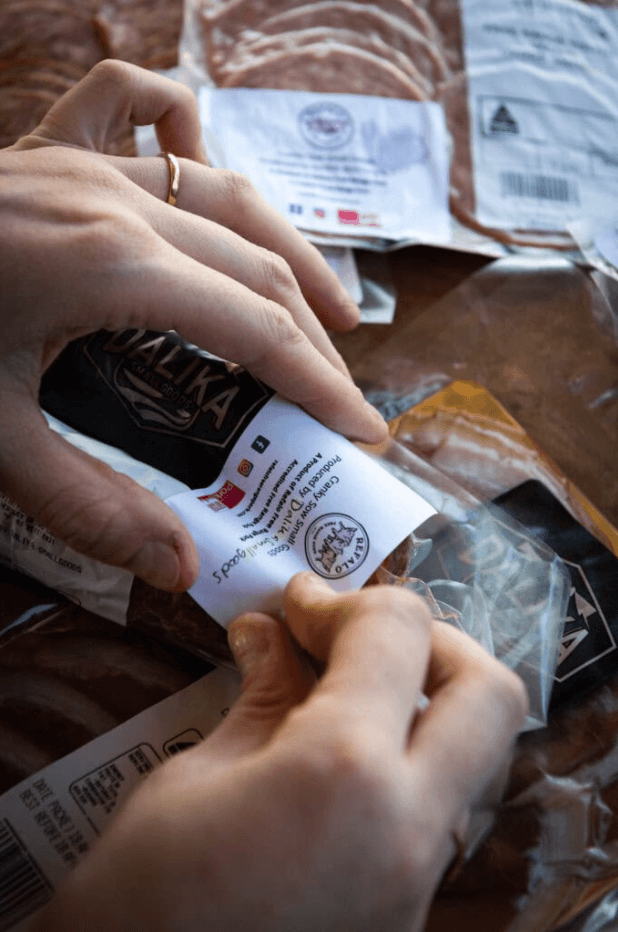
Cranky Sow Small Goods is named after the farm’s less forthcoming females.
By 16 weeks, the finisher pigs weigh around 80 kg. Every Monday, David takes a truckload of 35 to 45 pigs to the abattoir in Cowra for processing. Before Covid, most of his pigs were processed as suckling pigs for restaurants. Today, only 20 per cent are suckling, with the majority processed as heavy pigs for pork and smallgoods production.
Refalo Free Range Pork (RFRP) is supplied to more than 20 butchers and speciality food stores across NSW and the ACT, and is also available through David’s RFRP website. Griffith Butchery in Canberra and Dalika Small Goods in Sydney produce a wide range of smallgoods, from spicy salami, pepperoni, prosciutto and cabanossi to bacon, ham and other sliced meats.
David’s website smallgoods range is labelled “Cranky Sow”, named after his least friendly females. He also sells fresh pork and smallgoods direct to the public. Richard Odell, owner of Griffith Butchery, has sourced David’s RFRP pigs for the past three years.
“Our award-winning pork comes down to Dave’s hard work and free-ranging efforts,” says Richard.
“All our legs of ham are Refalo. The skin is thicker and softer, the meat-to-bone ratio is higher, and the colour is lighter and more flavoursome.”
In 2018, the NSW Farmers Pork Committee, a voice for the pig industry, invited David to join. The committee includes eight to nine members from across the pork sector, from large businesses to small farm operations like David’s. David is the only free-range farmer on the committee, as well as the longest-serving and youngest member.
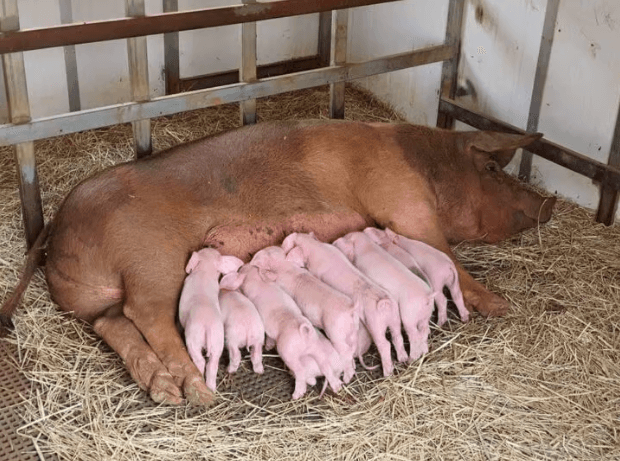
A farrowing shelter provides the right conditions for a sow and piglets.
While African swine fever (ASF) did not reach Australia in late 2019, the committee played a key role in arranging community advisory meetings in Young, NSW, focused on biosecurity and pre-planning.
More than 100 people attended, highlighting the seriousness of the risks facing farmers. “Illegal importation of contaminated pork is Australia’s biggest issue,” says David. “The virus can survive for many months in smallgoods. If backyard pig owners feed their animals swill, food scraps that could contain the virus, the infected meat only needs to be fed to one pig and we could have a huge problem.”
Between December 2021 and March 2022, several pork farmers had mosquito-borne Japanese encephalitis affect their herds. Early testing showed nothing. Sows were aborting, and young piglets were losing condition and dying within a week. Farmers were left confused. David says it is the worst disease he has experienced in 19 years of pig farming.
“Our pigs weren’t responding to antibiotics. It shows how fast things can change with livestock. Fortunately, we haven’t seen a return of the virus this past summer, but we are always vigilant.”
Raising pigs is not easy. It is continuous hard work, but David says it is in his genes and he has many plans ahead, including more land, more pigs, and growing into one of Australia’s largest family-owned free-range pig farms.
The latest for the NSW Farmers Pork Committee
Over the past 12 months, the NSW Farmers Pork Committee has been engaging strongly with industry and stakeholders alike on the National Livestock Identification System (NLIS) requirement to tag pigs under 25kg. A letter was written to the former NSW Agriculture Minister, advocating for a review of the NLIS standards and outlining the Committee’s request. The Committee continues to remain engaged with NSW DPI and APL on the literature review being undertaken on this matter and supports the practice of tattooing as a legitimate alternative to ear-tagging, as tattooing promotes higher OH&S, traceability, and animal welfare outcomes.
In 2022, the Pork Committee was made aware of the consultation by the NSW Environment Protection Agencies (NSW EPA) to review the EPA Climate Change policy. The draft policy suggests setting emissions targets for license holders and the NSW EPA holding license holders to these targets. NSW Farmers sent a letter to the NSW Minister for Environment and Heritage stating our position to have agriculture exempt from this scheme. The Pork Committee has engaged with the NSW EPA CEO on recent farm tours, highlighting industry concerns and the substantial progress and investments made by the pork industry to address emission outputs. Although the Committee remains concerned with the EPA’s proposed approach, it remains highly engaged in ongoing robust and constructive discussions with the NSW EPA CEO and staff about this policy.
Article reference: https://thefarmermagazine.com.au/pampering-pigs-is-simply-good-taste/
Authors: Nanette Holliday, Michelle Hespe